


The short answer
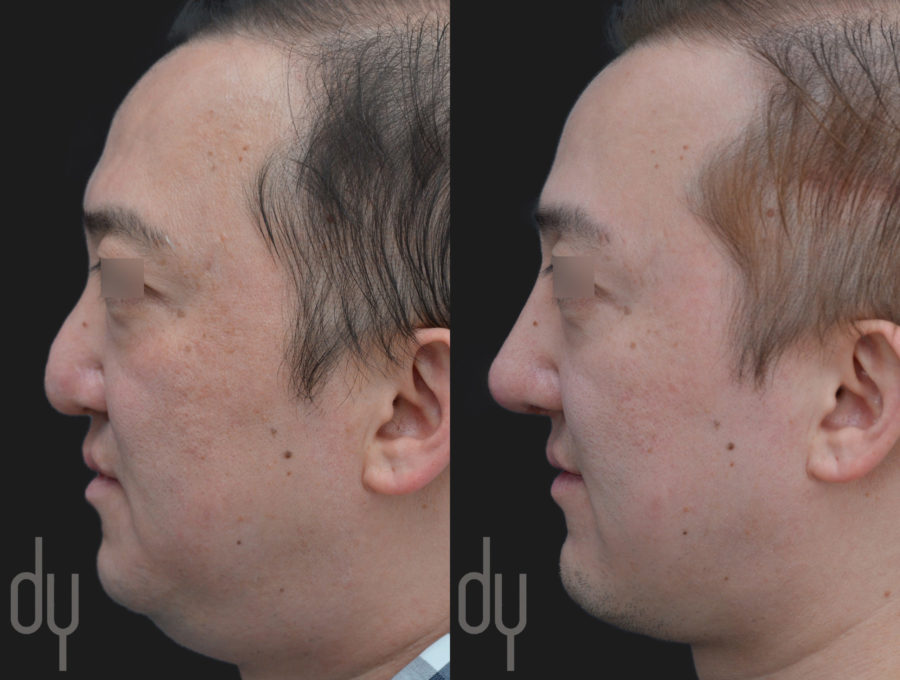
Often, the chin deserves a look before you decide on a rhinoplasty. When someone wants both a nose and a chin change, I proportion the nose to the ideal chin projection, and I match the chin to the middle and upper thirds of the face. The two are planned together, because they are read together in profile. This is one part of what I call facial balancing: planning the face as a connected system instead of one feature at a time.
Why the chin changes how your nose looks
In profile, the nose is judged against the chin. A chin that sits back can make a nose look more prominent, and a refined nose can look out of place if the lower face is not in proportion. A long-term study of combined rhinoplasty and genioplasty (chin surgery) concluded that even after a successful rhinoplasty, a face can lack aesthetic attractiveness if the profile is not addressed (Bertossi et al., 2013).

What the research shows
- Most rhinoplasty patients have a chin difference. In a study of 108 consecutive patients having a first rhinoplasty, every patient had some measurable chin difference: 58.3% had a small chin (microgenia) and 38% had chin asymmetry. All were offered chin correction, but only 10.1% had it (Coombs et al., Aesthetic Plastic Surgery, 2024).
- Doing both together can hold up over time. In 90 patients who had open rhinoplasty and genioplasty at the same time, the chin position stayed within 1 mm of the result after 3 years. This was a retrospective study, which is a lower level of evidence (Bertossi et al., JAMA Facial Plastic Surgery, 2013).
- The right chin technique depends on the chin. In a review of 345 cases of microgenia, the authors based their choice between sliding genioplasty, implants and fillers on the size of the chin defect, the thickness of the soft tissue, the patient’s age and the patient’s own view. In that series, sliding genioplasty gave the most predictable long-term result, a trade-off against how invasive the operation is that I weigh below (Bertossi et al., Aesthetic Plastic Surgery, 2015).
- Filler can help mild chin retrusion. In a randomized study of Chinese subjects, a flexible hyaluronic acid filler was effective and safe for mild to moderate chin retrusion (Xie et al., Aesthetic Plastic Surgery, 2024).
How I decide whether your chin needs to change
I do not plan from average numbers. I start with classic proportions, then look at your face through the lens of your ethnicity and your own aesthetic goals, and I assess your skin quality and the bone beneath it. Sometimes the right answer is a chin change together with the nose, and sometimes the chin should be left alone. The most important question is your aesthetic goals and priorities. You can read how I evaluate the whole face in my guide to facial balancing.
Why I favor a chin implant
For patients with normal occlusion who want a mild to moderate change, I favor chin augmentation with an implant. It is much less invasive than genioplasty, which involves cutting and repositioning the chin bone. Recovery is much quicker, and the aesthetic result is comparable for these patients. Genioplasty has a role, but for most of the people I see with a good bite and a mild to moderate chin deficiency, an implant gets them to the same place with less surgery.
When a chin implant works, and when it does not
A chin implant works very well when a patient has good occlusion, meaning the upper and lower teeth meet properly. If a patient has malocclusion, such as an underbite or an overbite, they are better served by a procedure that addresses the bite first, because it affects chin projection and overall facial balance. Placing an implant first can hide the real problem instead of solving it.
Asian patients: the jawline matters most
For Asian patients, especially Asian women, the chin does not need to project as far forward as it does for patients of other ethnicities. What matters most is the overall shape of the jawline and its feminine character. This is why I do not apply a single projection target to every face, and why the plan for the nose and the chin follows the whole lower face. See also my Asian rhinoplasty guide.
Chin options
- Chin augmentation with an implant (my preferred approach for normal occlusion and a mild to moderate change), or with fat.
- Hyaluronic acid filler for the chin and jawline, a non-surgical option for mild to moderate retrusion.
- Asian rhinoplasty and alarplasty (nostril shaping), planned together with the chin when the profile calls for it.
Together or in stages?
I combine procedures in one session when the effect is synergistic and doing them together will not delay healing compared with a single procedure. As long as all of the treatments can heal at the same time, they can be stacked into one session.
Recovery
For surgery, sutures stay in place for about one week, and most patients feel comfortable returning to work or school in about two weeks. For non-surgical procedures, downtime depends on the specific procedure but is typically minimal. I will explain what to expect for your plan at your consultation.
Frequently asked questions
Do I need a chin procedure if I am having a rhinoplasty?
Not always. It depends on your proportions, your bite and your goals. Many people benefit from looking at the chin and nose together before deciding.
Why an implant instead of genioplasty?
For patients with normal occlusion who want a mild to moderate change, an implant is much less invasive, has a much quicker recovery and produces a comparable aesthetic result.
I have an underbite or overbite. Is a chin implant right for me?
Often a procedure that addresses the bite should come first, because it changes chin projection and facial balance. We will go through this at your consultation.
Can I see how it might look beforehand?
When it is appropriate, yes. I can use computer simulation during your consultation to show how different changes might look.
How much does it cost?
Cost varies with the treatment or combination of procedures in your plan, so it is discussed once we know what your plan includes.
Start with a consultation
If you would like a plan that looks at your nose and chin together, request a consultation with Donald B. Yoo, M.D., F.A.C.S., or call 310-772-0766. 433 N. Camden Drive, Suite 970, Beverly Hills, CA 90210.
References
1. Coombs DM, Hua V, Patel V, Guyuron B. Chin dysmorphology in the primary rhinoplasty population. Aesthetic Plastic Surgery. 2024;48(2):177-186. PMID 37430011.
2. Bertossi D, et al. Combined rhinoplasty and genioplasty: long-term follow-up. JAMA Facial Plastic Surgery. 2013;15(3):192-197. PMID 23493992.
3. Bertossi D, et al. Chin microgenia: a clinical comparative study. Aesthetic Plastic Surgery. 2015;39(5):651-658. PMID 26130400.
4. Xie Y, et al. Chin augmentation and treatment of chin retrusion with a flexible hyaluronic acid filler. Aesthetic Plastic Surgery. 2024;48(5):1030-1036. PMID 38315229.







 Contact Us