


DRAFT NOTE (delete before publishing): every bracketed note below needs Dr. Yoo’s input. Patient consent for the images must be confirmed.
By Donald B. Yoo, M.D., F.A.C.S.
Key takeaways
- Facial balancing is not one operation. It is a way of planning, in which the face is treated as one connected system instead of one feature at a time.
- Changing one feature changes how the others read. A nose can look different once the chin is in proportion, and a lifted face can still look “off” if the temples and cheeks have lost volume.
- I plan around your own anatomy, your ethnicity and your idea of beauty, not around an average of other people’s measurements.
- Treatment can be non-surgical, surgical or a combination, and often the right plan includes less than you expected.
What is facial balancing?
Many people come in asking about a single feature: “my nose,” “my chin,” “I look tired.” Facial balancing is the step back from that single feature. It asks how the chin, jaw, cheeks, temples and nose relate to one another, and which of them, if any, is actually setting off the imbalance you see in the mirror.
This is why a face can look “off” after a good operation on one area. A lifted face with hollowed temples can still look older or oddly shaped. A refined nose can look prominent, or the lower face can look weak, when the chin is small. Treating the feature you noticed without asking about its neighbors is how results end up technically good and still not quite right.
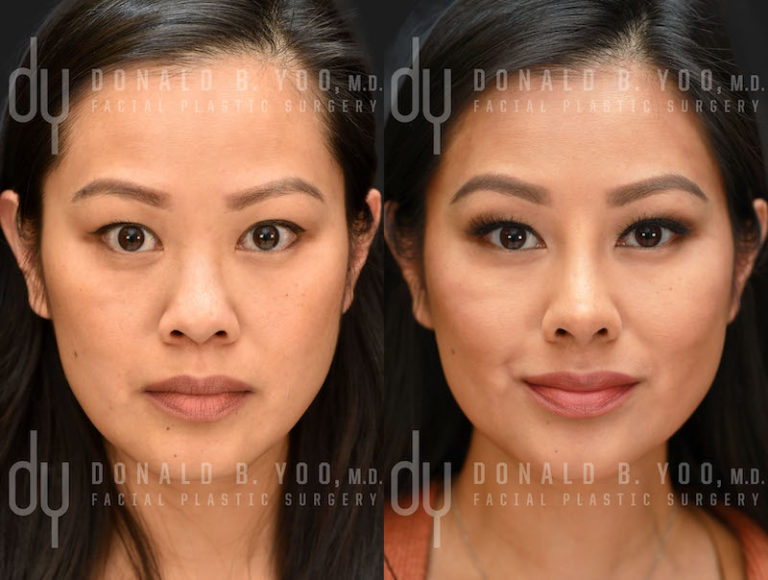
How the features interact
- Chin and nose. The chin sets how much the nose projects in profile. In a study of 108 consecutive patients having a first rhinoplasty, every patient had some measurable chin difference: 58.3% had a small chin (microgenia) and 38% had chin asymmetry. All were offered chin correction, but only 10.1% had it (Coombs et al., Aesthetic Plastic Surgery, 2024).
- Temples and cheeks. Temple volume loss changes the shape of the face from the top down, and no lift fixes volume that is no longer there.
- Jaw and neck. The jawline and neck define the lower third of the face and how heavy or light the chin reads.
- Nose and the rest of the face. For Asian patients, nasal planning depends on the dorsum, the tip and the surrounding features together, not on the nose alone. See my Asian rhinoplasty guide.
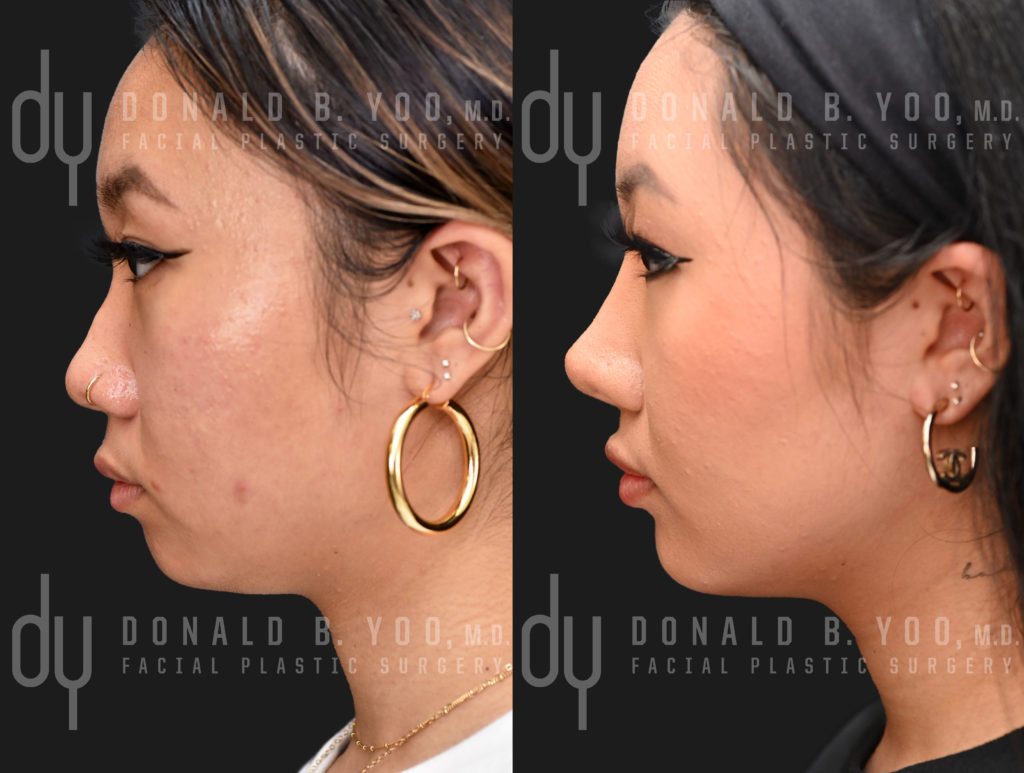
Why I do not plan from “ideal” numbers
AI chatbots can measure your face against the classic proportions: vertical thirds, horizontal fifths, the relationship of the inner corner of the eye to the nostril, canthal tilt. They can even simulate a “better” you. But those canons began as averages of many faces, and an average cannot tell you what suits one person. Think of it like hair: some women look beautiful with short hair, some with long, and averaging all of them gives a length that suits no one. I use measurements as a starting point and put them in the context of your anatomy, your ethnicity and your own beauty ideals. AI also cannot judge the bone and soft tissue under the skin, so what looks easy in a photo may not be possible in real life. More on this in my post Can AI tell me what I need to improve my facial balance?
How I evaluate your face
I begin with the classic proportions, because they give me a common language for what I am seeing. I look at the face in vertical thirds (the forehead, the middle of the face and the lower face) and in horizontal fifths (the width of the face divided into five roughly eye-width sections). I compare the intercanthal distance, the space between the inner corners of the eyes, with the interalar distance, the width of the nostril bases, because that relationship tells me a lot about how wide or narrow the nose sits within the face.
Those numbers are where the evaluation starts, not where it ends. A measurement only means something once I know whose face it is on. I look at every patient through the lens of their ethnicity, because features that read as balanced in one face can read differently in another, and because the proportions that suit an Asian face are not always the ones a textbook drawn from other populations would suggest. Then I ask what you want to look like. Two people with identical measurements can have very different goals, and the right plan follows your goals, not the average.
I also assess the skin and the bone beneath it. Skin quality and elasticity matter, and so does the way the soft tissue drapes over the facial skeleton, because all three together shape the contours of the face. A plan that ignores them can look right on a diagram and wrong in person. Two faces with the same bone structure can need very different treatments if one has firm, elastic skin and the other has lost volume or tone.
From there, I look at the chin, jaw, cheeks, temples and nose together, in front, three-quarter and profile views, and decide which one or two changes would make the biggest difference. Sometimes that is a single treatment. Sometimes the most useful advice is what to leave alone.
Facial balancing by area
Every face is different, so these are examples of how I think about each area, not a menu. Most plans use only one or two of them.
Chin and jawline
- Non-surgical: hyaluronic acid filler for projection and a more sculpted jawline; energy-based skin tightening and radiofrequency microneedling to firm the jawline and neckline; neurotoxin for masseter reduction to taper the jaw into a V-line.
- Surgical: chin augmentation with an implant or fat; neck liposuction; jawline and neck lifting as part of a facelift.
Cheeks and midface
- Non-surgical: filler to lift and restore midface projection; biostimulators such as Sculptra and Juvelook for subtle volume and skin quality; laser resurfacing for brightness; ultrasound-based lifting to tighten the midface.
- Surgical: fat grafting and facelift.
Temples, forehead and under-eyes
- Non-surgical: filler, biostimulators or platelet-rich fibrin gel to correct hollowing; skin boosters or exosomes for crepey texture; skin tightening around the eyes.
- Surgical: fat grafting, brow lift and eyelid surgery.
Nose
- Non-surgical: filler rhinoplasty to smooth a hump, lift the tip or improve symmetry with no downtime. See non-surgical rhinoplasty.
- Surgical: rhinoplasty and alarplasty, planned together with the chin.
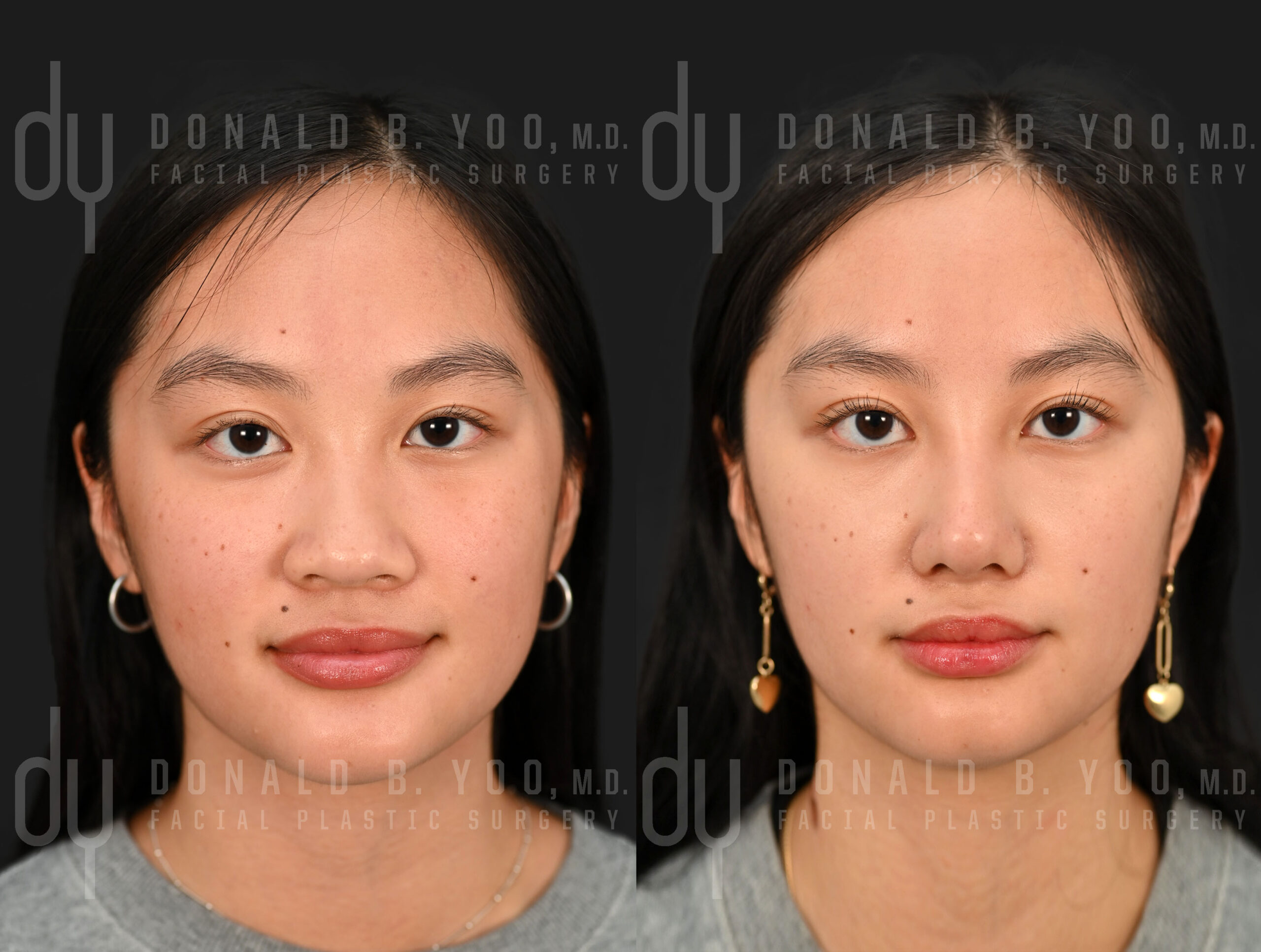
Skin quality and overall symmetry
- Neurotoxin (Botox, Letybo) to refine asymmetry and facial shape; laser and skin boosters to improve tone and texture; energy-based devices to lift several areas of the face at once.
How treatments are combined
I combine procedures in one session when the effect is synergistic and doing them together will not delay healing compared with a single procedure. As long as all of the treatments can heal at the same time, they can be stacked into one session.
When someone wants both a nose and a chin change, I proportion the nose to the ideal chin projection, and I match the chin to the middle and upper thirds of the face.
Whether a treatment is non-surgical or surgical is not the most important question. The most important question is your aesthetic goals and priorities, and the plan follows from those.
Treatment options
Non-surgical
- Energy-based skin tightening to sharpen the jawline and neckline.
- Hyaluronic acid fillers to augment areas such as the chin, cheeks, temples, forehead and nose in appropriate patients.
- Biostimulators, injectables that stimulate the body’s own collagen, including Sculptra, Juvelook and hyperdilute Radiesse.
- Neurotoxin injections to strategically reshape the face in certain areas, such as Botox for masseter reduction to create a more tapered, V-line jawline.
For non-surgical options such as skin tightening, biostimulators and fillers, see HALO Beverly Hills’ facial balancing page.
Surgical
- Fat grafting to restore volume. In a pooled analysis of studies measuring volume, about 47% of grafted fat was retained (95% confidence interval 41-53%), with complications in 2.8% of patients; the authors concluded that exact retention is unpredictable (Lv et al., Aesthetic Plastic Surgery, 2021). I plan with that in mind instead of promising a fixed result.
- Chin augmentation with an implant or fat.
- Rhinoplasty and alarplasty (nostril shaping) planned together with the chin.
- Facelift, jawline and neck procedures.
Combined
Many people do best with a combination, done together or in stages. In one study of Asian patients, rhinoplasty combined with full-face fat transfer increased nasal projection, changed the angle between the nose and upper lip from a median of 106 to 101 degrees, and was reported without complications, though it was a small retrospective study (An et al., Aesthetic Plastic Surgery, 2023).
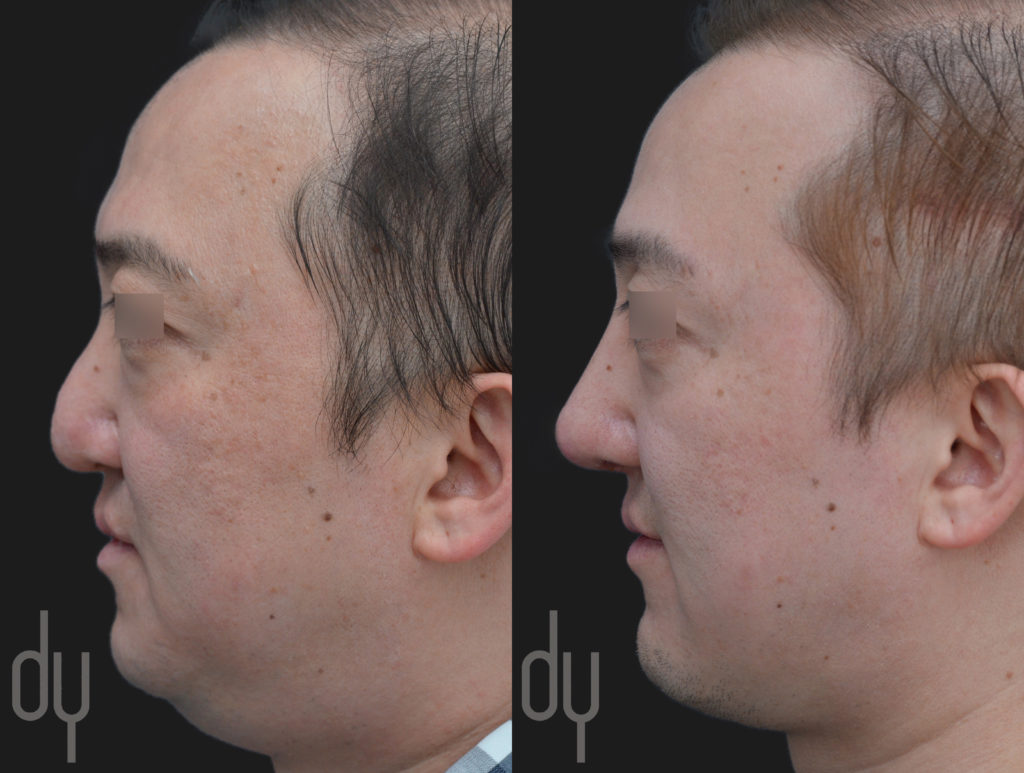
Who is a good candidate?
Anyone who feels bothered by their facial proportions, or who senses that the balance of their face is off, is a good person to talk to. You do not need to know which feature is the cause. Often that is exactly what a consultation is for. With a keen aesthetic eye, small interventions can sometimes be enough to bring a face into balance, so the answer is not always a large procedure.
What to expect
A consultation typically lasts 45 minutes to an hour. We go through your concerns and goals, I examine your face in several views, and when it is appropriate, I use computer simulation so you can see how different changes might look. For surgery, sutures stay in place for about one week, and most patients feel comfortable returning to work or school in about two weeks. For non-surgical procedures, downtime depends on the specific procedure but is typically minimal. I will explain what to expect for each option in your plan at your consultation.
Frequently asked questions
Is facial balancing one surgery?
No. It is a plan that may include one procedure, several or none.
Will I look different?
The aim is for you to look like yourself, with features that sit well together.
Can I do this without surgery?
Sometimes. Energy-based skin tightening can sharpen the jawline and neckline, hyaluronic acid fillers can augment areas such as the chin, cheeks, temples, forehead and nose in appropriate patients, biostimulators such as Sculptra, Juvelook and hyperdilute Radiesse can stimulate the body’s own collagen, and neurotoxin injections can reshape areas such as the masseter muscle to taper the jawline. They can restore volume and rebalance proportions, but they cannot reshape bone or remove tissue.
What if I only want one change?
That is fine. A plan can be a single treatment.
Can I preview the result?
When it is appropriate, yes. I can use computer simulation during your consultation to show how different changes might look.
Should I do my nose or my chin first?
They are planned together. I proportion the nose to the ideal chin projection, and I match the chin to the middle and upper thirds of the face.
How long do results last?
It depends on the specific treatment or combination of procedures. Your plan will spell out what to expect for each part.
How much does it cost?
Cost varies with the treatment or combination of procedures in your plan, so it is discussed once we know what your plan includes.
Start with a consultation
If you would like a plan that looks at the whole face, request a consultation or call 310-772-0766. 433 N. Camden Drive, Suite 970, Beverly Hills, CA 90210.
References
- Coombs DM, Hua V, Patel V, Guyuron B. Chin dysmorphology in the primary rhinoplasty population. Aesthetic Plastic Surgery. 2024;48(2):177-186. PMID 37430011.
- An Y, Wang G, Li X, et al. Rhinoplasty with simultaneous autologous full-face fat transfer for Asian facial contouring balance: a retrospective study. Aesthetic Plastic Surgery. 2023;47(2):746-756. PMID 36042025.
- Lv Q, Li X, Qi Y, et al. Volume retention after facial fat grafting and relevant factors: a systematic review and meta-analysis. Aesthetic Plastic Surgery. 2021;45(2):506-520. PMID 31940073.
- Facial anthropometric measurements and principles: overview and implications for aesthetic surgery. Facial Plastic Surgery. 2024;40(3):348-362. PMID 37487528.







 Contact Us