


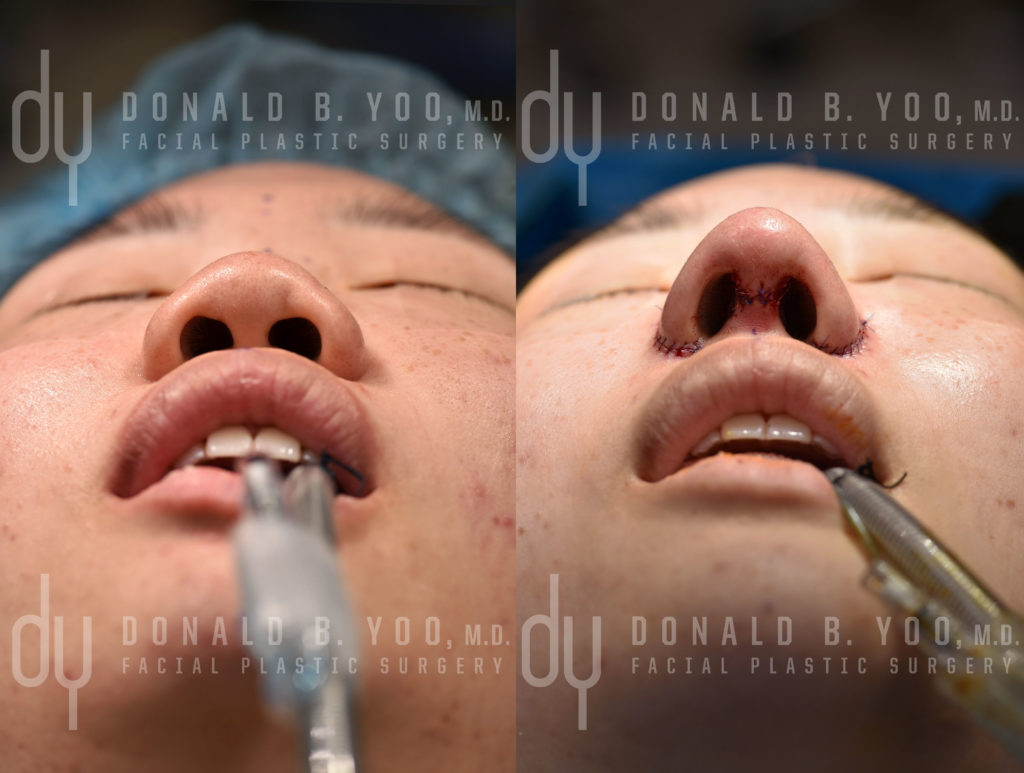
Counter to what you may have thought, the best candidates for Asian rhinoplasty are not always Asian. Asian rhinoplasty refers to a subset of nose job surgery that addresses a common array of anatomic characteristics that are common, but not exclusive, to patients of Asian ethnicity. The Asian rhinoplasty specialist will commonly encounter a softer cartilaginous framework, especially along the nasal tip, a low and often slightly wider dorsum, and skin that tends to be more sebaceous and thicker than a typical patient seeking a more traditional reductive rhinoplasty.
Who’s a Good Candidate for Asian Rhinoplasty?
Amongst patients with these anatomic generalities, which patients will have the highest chance of success? Success in plastic surgery, and specifically in Asian rhinoplasty surgery, comes down to the alignment between expectations and reality. Significant changes and dramatic amounts of refinements can be made during Asian nose job surgery, however there are limitations to the kinds of shape changes possible based on the baseline individual anatomy. For example, in a patient with thicker skin, the nasal tip can not be made as razor sharp as a patient with thin skin, nor would you necessarily want it to be. A beautiful Asian nose means a nose that blends and complements the other facial features. An additional consideration prior to surgery is the overall height and width of the nose. While the nose can be made significantly slimmer from the frontal view during Asian rhinoplasty surgery, in the setting of thick skin this also means that this will necessitate a certain amount of projection from the profile view as the structure of the nose must press against the skin to create definition. The change in the overall width of the nose will also be dictated by the attachment of the ala and nostrils to the face, and the amount narrowing that can be achieved along the tip of the nose, as balance and aesthetic proportions of the nose must always be preserved. The best candidate for Asian rhinoplasty, then, will have some understanding and awareness of these nuances prior to pursuing surgery.
Recovery Expectations
The successful candidate for Asian nose job surgery will also have emotionally and mentally prepared for the slightly prolonged and gradual nature of rhinoplasty recovery. Unlike some surgeries where the final result appears once the sutures are removed, recovery after Asian rhinoplasty involves months, and up to two years, of healing before the final result is seen. While much of the swelling will resolve in the first 3-6 months after surgery, patients should anticipate continued de-swelling and refinement of the nose for the first two years after surgery. Early during the recovery process swelling will cause the nose to appear bigger and taller than the final result, and successful candidates will expect and embrace this gradual recovery process towards a beautiful, permanent change.

Another important characteristic of successful candidates for Asian rhinoplasty surgery may be less obvious, but no less important. The goal of Asian rhinoplasty surgery is to enhance your looks and to optimize the form and function of your nose, not to create a perfect nose nor to transform you into someone else. Surgery will not make you happy, nor will it change your life; those things come from within. Surgery simply helps better reflect the beauty that already rests inside. For that reason, patients seeking improvement, not perfection, make the most successful candidates for Asian nose job surgery.
What Rib Cartilage Adds to the Results
Rib cartilage provides additional support and structure to your nose. Instead of replacing the cartilage that is inside your nose it supplements it, creating greater strength and structure to reshape the skin envelope. This means that a nose that undergoes Asian rhinoplasty with rib cartilage is actually stronger than a nose that has never had surgery, and therefore will be more resistant to changes that occur during the aging process. As we all age, the skin and ligaments that support the nose become more lax and gravity pulls on the structures of the nose. This results in the tip of the nose becoming more ptotic, or droopy, with time. With rib cartilage, the nasal tip will maintain the tip support and angle more reliably than just the natural nasal cartilage alone. It takes about 2-3 months of healing for the rib cartilage to become integrated into the nose, complete with a blood supply nourishing it. After this, it remains a permanent part of the nose.
Learn more about Asian Rhinoplasty here


 Contact Us