


Asian rhinoplasty and alarplasty are two of the most frequently paired procedures in my practice, and for good reason: they address related but distinct concerns that, left uncorrected together, can leave a result feeling incomplete. Understanding why these two are so often combined — and what that combination actually involves — helps set clearer expectations going into surgery.
What Each Procedure Addresses on Its Own
Asian rhinoplasty typically focuses on the bridge and tip of the nose — building dorsal height, improving tip projection and definition, and refining the profile and frontal view.
Alarplasty (nostril reduction) addresses the base of the nose — specifically the width and flare of the nostrils (alar base) — through a precise reduction of tissue at the base, narrowing nostril width and/or flare without altering the tip or bridge.
Why They’re So Often Combined
Raising the bridge and refining the tip through rhinoplasty can, in some patients, make an already wide or flared nasal base appear proportionally more noticeable by comparison — since the upper two-thirds of the nose is now more refined and defined, drawing more visual attention to the base. For patients who have both a lower dorsum/under-projected tip and nasal base width as concerns, addressing only one without the other can leave the result looking unbalanced rather than fully resolved.
Combining the two in a single surgery allows the entire nose to be planned and proportioned together, rather than making tip and bridge changes in isolation and only later discovering the base now looks disproportionate.
Is Combining Them Always Necessary?
No. Not every Asian rhinoplasty patient needs or wants alarplasty, and not every alarplasty patient needs rhinoplasty. Nasal base width and flare exist independently of bridge height and tip projection — some patients have significant base width with an otherwise well-proportioned bridge and tip, and are excellent alarplasty-only candidates. The decision to combine should be based on your specific anatomy and goals, not a default assumption that the two always go together.
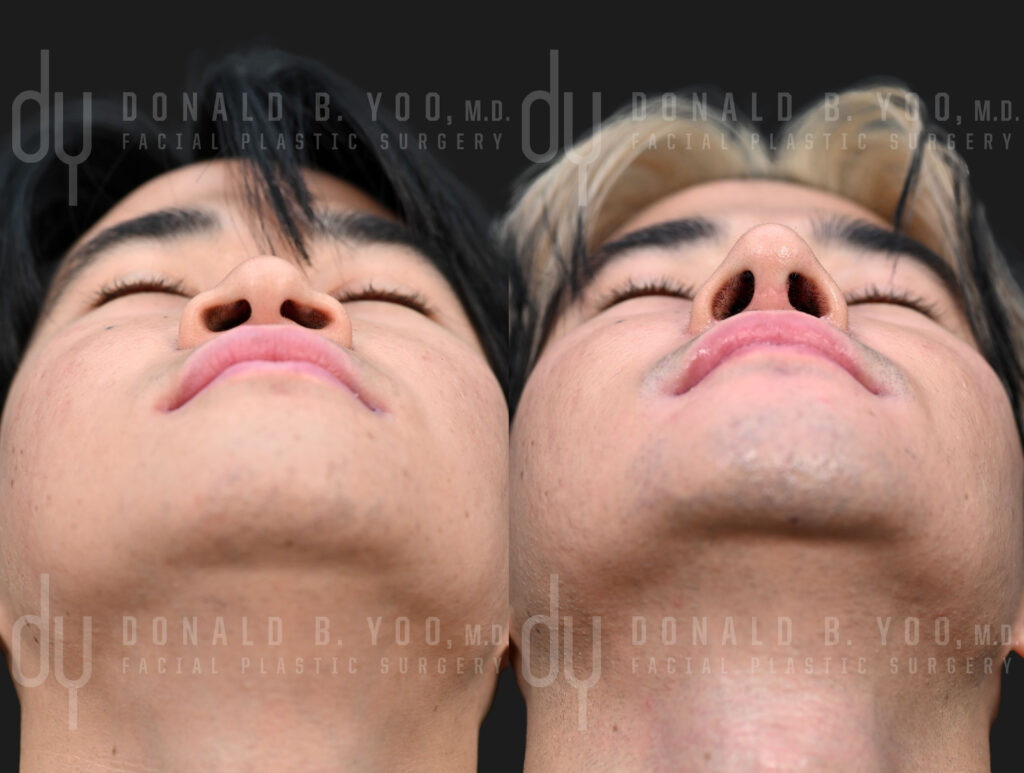
What to Expect From Combined Surgery
Surgical planning. Both areas are addressed within the same operation, planned together so the final proportions of bridge, tip, and base are considered as a whole rather than sequentially.
Recovery. Combining the two procedures does not typically add significant additional downtime beyond rhinoplasty recovery alone — alarplasty incisions are small and heal relatively quickly, and most of the visible swelling and bruising timeline is driven by the rhinoplasty portion of the surgery.
Scarring. Alarplasty incisions are placed carefully within the natural crease where the nostril meets the cheek, and when performed with meticulous technique, typically heal to be very inconspicuous.
Single anesthesia and recovery period. For patients who need both, combining avoids a second surgery, second anesthesia exposure, and second recovery period — a meaningful practical advantage beyond the aesthetic reasoning.

Frequently Asked Questions
Does everyone who gets Asian rhinoplasty also need alarplasty?
No. Whether alarplasty is recommended depends specifically on nasal base width and flare, which varies independently of bridge and tip anatomy. Many Asian rhinoplasty patients don’t need or choose alarplasty at all.
Will combining alarplasty with rhinoplasty extend my recovery time?
Not significantly. Alarplasty incisions are small and heal quickly, so combined recovery is driven mostly by the rhinoplasty portion rather than adding meaningful extra downtime.
Can alarplasty be performed alone, without rhinoplasty?
Yes. Alarplasty is commonly performed as a standalone procedure for patients whose primary concern is nasal base width or flare, without needing changes to the bridge or tip.
Will alarplasty scars be visible?
When incisions are placed precisely within the natural crease where the nostril meets the cheek and closed meticulously, scarring is typically very inconspicuous and difficult to detect once healed.
How do I know if I need both procedures?
This is best determined during consultation, evaluating bridge height, tip projection, and nasal base width and flare as related but distinct components of your overall nasal anatomy and goals.
Final Thoughts
Asian rhinoplasty and alarplasty solve different problems, but planning them together — when both are genuinely needed — produces a more proportionate, complete result than addressing one in isolation. If you’re considering Asian rhinoplasty, alarplasty, or both, I encourage you to schedule a consultation to discuss which approach fits your anatomy.
Donald B. Yoo, M.D., F.A.C.S. is a double board-certified facial plastic surgeon and Medical Director of HALO Beverly Hills, specializing in Asian rhinoplasty, revision rhinoplasty, and alarplasty. His office is located at 433 N. Camden Drive, Suite 970, Beverly Hills, CA 90210.


 Contact Us