


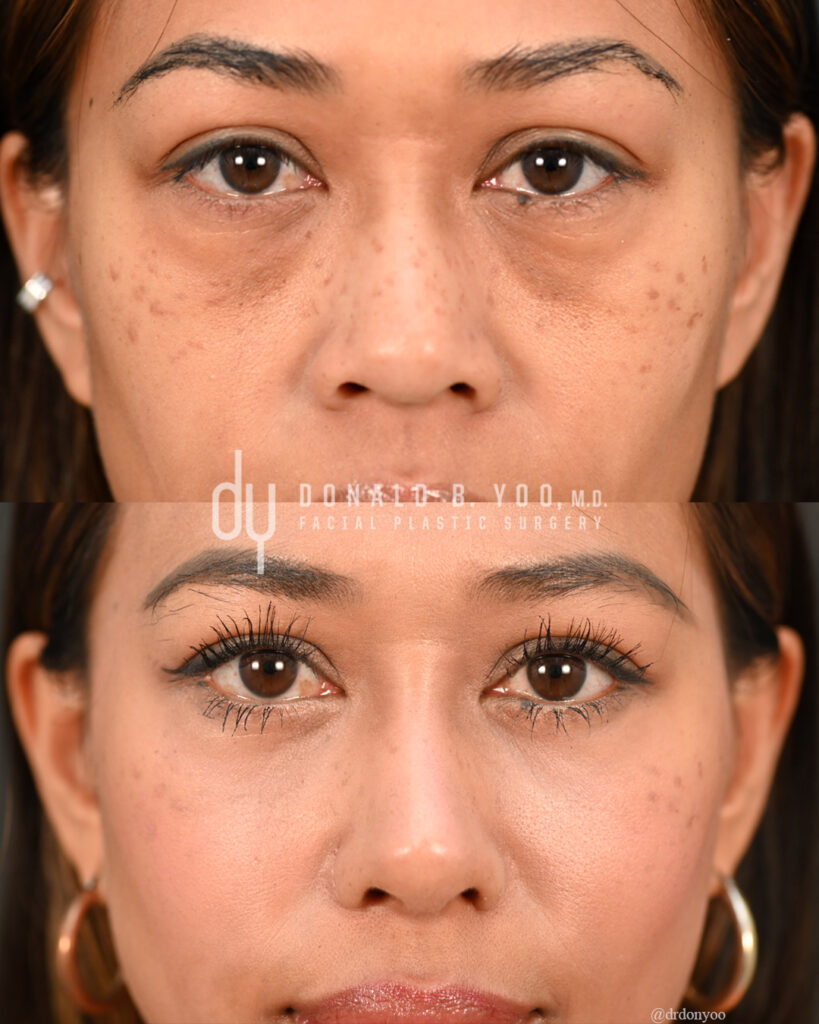
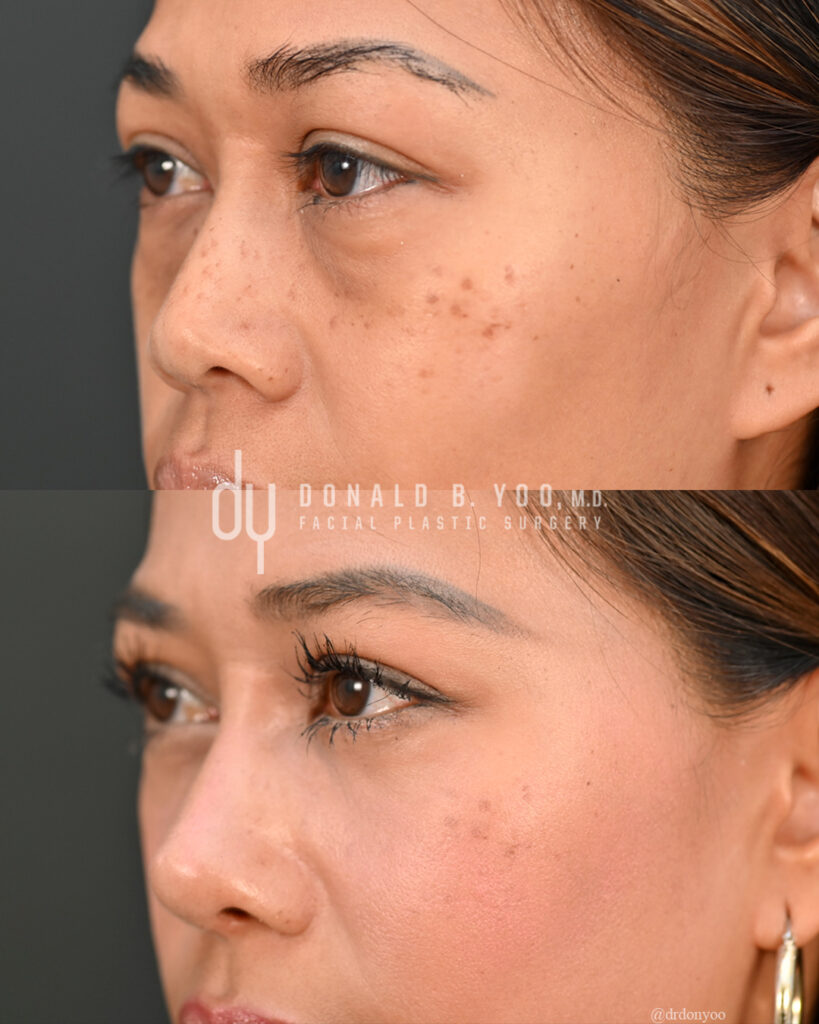
Patient had lower blepharoplasty with rhinoplasty. Individual results vary.
One of the first questions I hear at lower eyelid consultations is not about the result. It is “How long will I look like I had surgery?” That is a fair question, and the answer depends on the technique. Here is what recovery looks like after the transconjunctival lower blepharoplasty I perform, so you can plan your time off and know what to expect.
Why the Approach Matters for Recovery
In a transconjunctival lower blepharoplasty, the incision is made on the inside of the lower eyelid. There is no incision on the skin, so there is no visible scar. If you want a deeper comparison with the skin-incision approach, I wrote about it in transconjunctival vs. subciliary lower blepharoplasty.
Your Recovery Timeline
The first week. Small bolsters are placed on the cheek and stay in place for the first week. After that week, they are removed.
After the bolsters come off. A little bruising and swelling will still be visible once the bolsters are removed. Everyone heals at a different pace.
Sleeping position. Keep the head of your bed elevated for the first 2 weeks.
Returning to work or school. Most patients feel comfortable returning to work or school about 2 weeks after surgery.
Eye makeup. Eyeliner, mascara and false lashes can be used at 2 weeks. Eye shadow can be used at 4 weeks.
Why the Transconjunctival Approach Is Gentle on the Lower Eyelid
A review in Facial Plastic Surgery Clinics of North America notes that the transconjunctival approach can preserve the support function of the orbicularis muscle, the muscle that supports the lower eyelid. That may lower the risk of complications such as lower eyelid retraction and ectropion, where the eyelid pulls down or turns outward. Another review in the same journal describes transconjunctival lower blepharoplasty as safe and effective with a low complication rate, and notes that success depends on careful patient analysis and selection.
What Influences How Much Bruising and Swelling You Have
Technique matters. In a comparison I published in JAMA Facial Plastic Surgery, my colleagues and I reviewed 40 patients who had fat repositioned to the lower eyelid and cheek at two different tissue depths. The approach that disturbed less tissue led to less bleeding. The faster approach was more traumatic and led to more bruising, swelling and temporary contour irregularities. The final aesthetic result did not differ significantly between the two approaches, and all patients reported being satisfied. The takeaway is that how gently the surgery is performed shapes your recovery, even when the final result is similar.
Is the Transconjunctival Approach Right for You?
Success with this procedure depends on careful patient analysis and selection, so the right plan depends on your anatomy. Transconjunctival surgery works best when there is little excess lower eyelid skin. If you have loose or excess skin, that changes the plan, and I assess it in person.
Frequently Asked Questions
You will have bolsters on your cheeks for the first week. After they are removed, a little bruising and swelling will still be visible. Most patients feel comfortable returning to work or school in about 2 weeks. Healing varies from person to person.
Keep the head of your bed elevated for 2 weeks after surgery.
Eyeliner, mascara and false lashes can be used at 2 weeks. Eye shadow can be used at 4 weeks.
No. In the transconjunctival approach the incision is made on the inside of the lower eyelid, so there is no visible scar on the skin.
They are small supports placed on the cheek after surgery. They stay in place for the first week and are then removed.
Most patients feel comfortable returning in about 2 weeks. A little bruising and swelling may still be visible at that point.
It works best when there is little excess skin. If you have more skin laxity, we will discuss the best plan for you at your consultation.
Final Thoughts
Knowing what to expect makes recovery much easier to plan around. If you are considering lower eyelid surgery and want to talk through your timeline, I encourage you to schedule a consultation so we can look at your anatomy and goals together. You can also read more about lower blepharoplasty.
Donald B. Yoo, M.D., F.A.C.S. is a double board-certified facial plastic surgeon and Medical Director of HALO Beverly Hills, specializing in lower blepharoplasty, Asian rhinoplasty, and facelift surgery. His office is located at 433 N. Camden Drive, Suite 970, Beverly Hills, CA 90210.
References
- Yoo DB, Peng GL, Massry GG. Transconjunctival lower blepharoplasty with fat repositioning: a retrospective comparison of transposing fat to the subperiosteal vs supraperiosteal planes. JAMA Facial Plast Surg. 2013;15(3):176-181. doi:10.1001/jamafacial.2013.749
- Fedok FG. Transconjunctival lower blepharoplasty. Facial Plast Surg Clin North Am. 2026;34(1):131-143. doi:10.1016/j.fsc.2025.08.005
- Sarhaddi D, Nahai FR, Nahai F. Transconjunctival lower lid blepharoplasty with and without fat preservation and skin resurfacing. Facial Plast Surg Clin North Am. 2021;29(2):229-241. doi:10.1016/j.fsc.2021.01.004


 Contact Us
Pingback: Transconjunctival vs. Subciliary Lower Blepharoplasty: Pros, Cons, and Scarring - Beverly Hills Facial Plastic Surgery - Donald B. Yoo M.D.Beverly Hills Facial Plastic Surgery – Donald B. Yoo M.D.