


When patients research Asian rhinoplasty, they quickly run into a question that does not come up in many other cosmetic procedures: where will the cartilage come from? The graft shapes how strong the result is, how well it holds its position over the years, and what the recovery involves. Given the better long-term safety profile and durability of using your own viable tissue, many contemporary Asian rhinoplasty surgeons, myself included, have moved away from synthetic grafts and toward autologous grafts, and for the structural work most Asian noses need, I rely on rib cartilage. Here is why, and where septal and ear cartilage still have a role.
What the Asian Nose Asks of a Graft
Asian rhinoplasty usually adds structure rather than removing it. Many patients have a thicker skin envelope, a lower bridge and tip, and less native cartilage to work with. That means the graft has to do two things: supply enough volume, and keep its shape and projection under the constant pressure of thick skin for years after surgery. Strength on day one is not enough. The real test is what the nose looks like at year five. For more on how approaches have changed, see my post on contemporary approaches in Asian rhinoplasty.
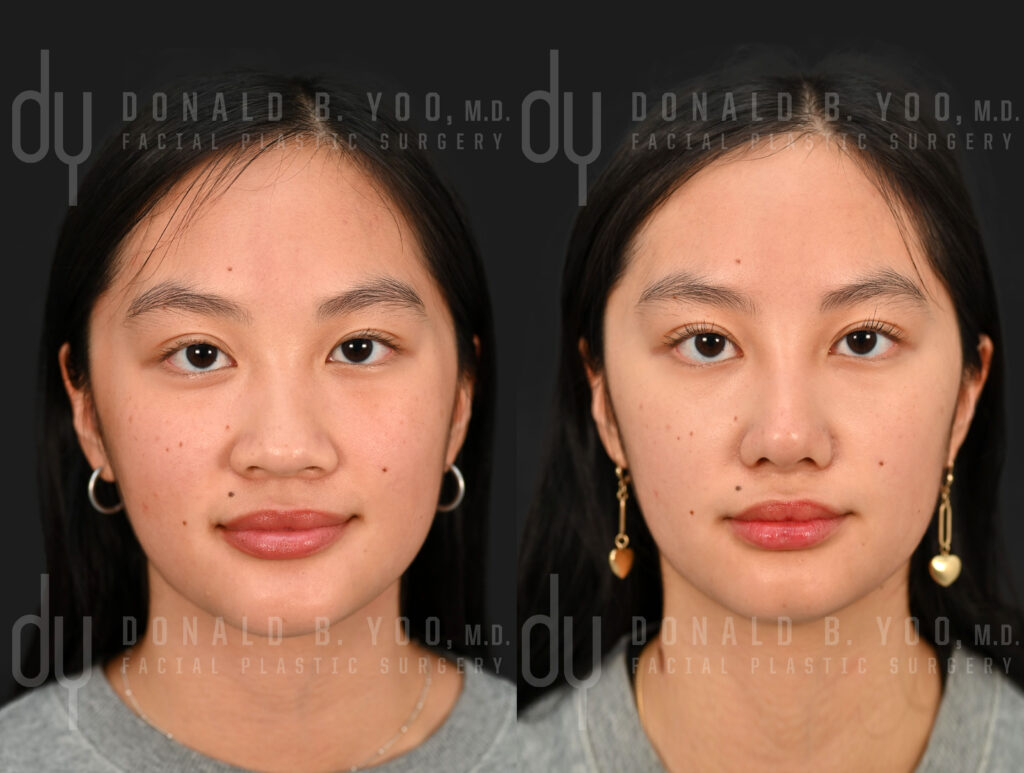
Rib (Costal) Cartilage: Volume, Strength, and Long-Term Stability
Rib cartilage provides the most volume and the most strength of any autologous (your own tissue) source, which is why it is the workhorse for significant augmentation and for revision cases.
It also appears to hold up better over time. In a 2023 comparison of 53 patients published in the Journal of Plastic, Reconstructive & Aesthetic Surgery, nose shape was measured with three-dimensional photogrammetry before surgery, immediately after, and over the long term. Patients who received rib cartilage septal extension grafts maintained tip height, nasal length, and tip rotation better over time than patients who received septal cartilage. The authors concluded that even a thin rib graft has enough intrinsic strength to hold the tip, including in patients with thick skin and a short nose.
A separate retrospective study of 27 Asian patients undergoing nasal tip surgery found that ear cartilage cap grafts lost significantly more tip height and volume over the long term than rib cartilage used as a septal extension and cap graft, although both supported the tip well in the short term. Both studies are small and retrospective, so I read them as consistent and supportive rather than final.
Rib cartilage has real tradeoffs, and patients should hear them:
- Warping. Costal cartilage can bend over time, and this is a recognized concern in the surgical literature.
- A donor-site incision. I harvest through an incision of about 1 cm placed in the inframammary crease, the fold beneath the breast, where it typically heals as a thin line hidden within the crease. Working through an incision that small is more technically demanding, and it is an approach I am very comfortable performing. In the first few days, most patients describe a muscle soreness like having done hundreds of sit-ups, most noticeable when getting up or coughing, but not enough to keep them from daily activities. I encourage patients to take walks around the neighborhood and, if they feel up for it, to go out to eat or shop. By one week the rib discomfort is mostly gone, and by two weeks patients can typically return to light exercise, including weights up to 30 pounds, and cardio.
- More involved surgery, because the graft must be carved and prepared carefully.
This is why technique matters as much as material. Careful carving, internal stabilization, and using cartilage in diced form wrapped in fascia reduce the risk of warping and visible edges. In the 2023 comparison above, the ultrafine diced cartilage wrapped in fascia showed roughly 7.5% resorption, which the authors linked to a lower likelihood of dorsal irregularity and stepping deformity.
Diced Cartilage Fascia
Diced cartilage fascia (DCF) means finely dicing cartilage and wrapping it in fascia, a thin layer of connective tissue, to form a smooth, moldable graft for the bridge. Compared with a single solid piece, it allows more precise contouring and tends to carry a lower risk of visible edges and irregularities.
Septal Cartilage: Excellent Material, Limited Supply
Septal cartilage comes from the wall inside the nose, and it is a good graft where enough of it exists. It requires no separate donor site, and the general rhinoplasty literature describes low rates of resorption and deformation. It works well for structural grafts such as a septal extension graft.
The limits show up in two ways. First, quantity: septal cartilage is often thinner and less abundant in Asian patients, and in revision surgery some may already have been used. Second, long-term position: in the direct comparison described above, septal cartilage extension grafts did not maintain tip height, nasal length, and tip rotation as well as rib cartilage grafts. For modest changes septal cartilage can be enough, but for significant augmentation or lasting tip support it often is not.
Ear (Conchal) Cartilage: Refinement, Not Foundation
Ear cartilage is soft and flexible, with a natural curve, which makes it very useful for camouflage and for improving contour. It can also be used for small volumes of augmentation along the bridge. Because it is softer than septal or rib cartilage, it provides little support, and given the long-term findings above, I do not rely on it for structural support or lasting projection.
Often, the Answer Is More Than One Material
In practice, many plans use more than one graft, with each material assigned the job it does best, for example septal cartilage where there is enough of it and rib cartilage for the bridge and tip support. Your own plan depends on how much cartilage you have, your skin thickness, whether you have had prior surgery, and the result you want.
Frequently Asked Questions
For significant augmentation or tip support, rib cartilage provides the most volume and strength, and the available long-term data in Asian patients favor it over both ear and septal cartilage for maintaining tip height and projection. Septal cartilage is an excellent graft where enough exists, and ear cartilage suits refinement. The right plan depends on your anatomy and goals.
Septal cartilage tends to be thinner and less abundant in Asian patients, and revision patients may have less remaining. In a direct comparison, rib cartilage extension grafts also maintained tip height and rotation better over time.
Warping is a recognized risk with costal cartilage. Careful carving, internal stabilization, and using the cartilage in diced form wrapped in fascia are aimed at reducing it.
Ear cartilage is soft and flexible, so it works well for camouflage and for improving contour, and it can add small volumes along the bridge. It is not a good choice for support: in one long-term comparison in Asian patients, ear cartilage tip grafts lost more height and volume than rib cartilage grafts.
I harvest through an incision of about 1 cm in the inframammary crease, the fold beneath the breast, where it typically heals as a thin line hidden in the crease.
In the first few days, most patients describe a muscle soreness like having done hundreds of sit-ups, most noticeable when getting up or coughing, but not enough to keep them from daily activities. By one week the rib discomfort is mostly gone, and by two weeks patients can typically return to light exercise, including weights up to 30 pounds, and cardio.
Final Thoughts
Graft selection is one of the most important decisions in Asian rhinoplasty, and it should follow from your anatomy and how you want the result to look years from now, not only at six months. If you are weighing your options, I encourage you to schedule a consultation to discuss which approach fits your goals.
Donald B. Yoo, M.D., F.A.C.S. is a double board-certified facial plastic surgeon and Medical Director of HALO Beverly Hills, specializing in Asian rhinoplasty, revision rhinoplasty, and alarplasty. His office is located at 433 N. Camden Drive, Suite 970, Beverly Hills, CA 90210.
References
- Park H, Kim Y, Choi JW. Asian rhinoplasty using a thin rib cartilage graft and ultrafine diced cartilage wrapped in fascia: a comparative study between septal cartilage graft and rib cartilage graft. J Plast Reconstr Aesthet Surg. 2023.
- Long-Term Resorption Rates of Conchal and Rib Cartilage Grafts in Nasal Tip Plasty in Asian Patients: A Retrospective Study. Aesthetic Plast Surg. 2025. PMID 39890635.


 Contact Us
Pingback: Contemporary Approaches in Asian Rhinoplasty: What's Changed - Beverly Hills Facial Plastic Surgery - Donald B. Yoo M.D.Beverly Hills Facial Plastic Surgery – Donald B. Yoo M.D.
Pingback: How to Choose an Asian Rhinoplasty Surgeon: Questions to Ask - Beverly Hills Facial Plastic Surgery - Donald B. Yoo M.D.Beverly Hills Facial Plastic Surgery – Donald B. Yoo M.D.
Pingback: Asian Rhinoplasty Before & After: What Changes and What Doesn't - Beverly Hills Facial Plastic Surgery - Donald B. Yoo M.D.Beverly Hills Facial Plastic Surgery – Donald B. Yoo M.D.