


One of the most common — and rarely voiced — concerns patients bring into an Asian rhinoplasty consultation is a version of the same question: will this still look like my nose, or will it look like someone else’s nose placed on my face? Patients have understandably seen before-and-afters online where the result looks generically “done,” disconnected from the rest of the patient’s face and ethnic features. Understanding what a well-planned Asian rhinoplasty actually changes — and just as importantly, what it deliberately preserves — addresses this concern directly.
The Goal Is Refinement, Not Effacement
Asian rhinoplasty differs fundamentally from Western rhinoplasty in its basic objective. Western rhinoplasty is frequently a reductive surgery — removing a dorsal hump, narrowing a wide tip. Asian rhinoplasty is, in the majority of cases, an augmentative surgery — building height along the dorsum, improving tip projection and definition, working with a nose that typically has thinner structural support and a lower profile to begin with.
This distinction matters enormously for the “will I still look like myself” concern: the surgical goal was never to reduce or erase ethnic features. A well-performed Asian rhinoplasty enhances facial harmony and balance while preserving — not effacing — the patient’s ethnic identity.
What Typically Changes
- Dorsal height — building a more defined bridge where the natural dorsum is low, improving the profile view
- Tip projection and definition — creating more refinement and structure at the tip, which is often under-projected and poorly defined in the untreated Asian nose
- Nasal-facial balance — improving how the nose relates proportionally to the rest of the face, particularly the chin and midface
What Is Deliberately Preserved
- Ethnic facial harmony — the surgical plan is built around what looks proportionate and natural specifically on that patient’s face, not toward a generic, ethnically nonspecific “ideal” nose
- Skin thickness and character — the thicker skin envelope common in Asian noses is a starting condition that shapes technique, not something rhinoplasty erases
- Natural movement and expression — a well-executed structural rhinoplasty preserves natural tip mobility and expression rather than creating a stiff, over-operated appearance
Why “Natural” Results Depend Heavily on Technique
Much of the anxiety around before-and-after photos online stems from outdated technique — particularly older silicone implant augmentation, which can create a shiny, overly straight, “stick-like” dorsal appearance that reads as artificial precisely because it doesn’t integrate with the patient’s own tissue and facial structure. Contemporary autologous techniques — using the patient’s own cartilage and tissue, individually planned rather than applied generically — are a large part of why modern Asian rhinoplasty results can look integrated and natural rather than imposed.
This is also why surgeon-specific planning matters so much: two patients with similar starting anatomy may need meaningfully different tip and dorsal proportions to look natural and balanced on their own individual face.
Before and After: What to Look For
When reviewing before-and-after photos — your own surgeon’s or otherwise — it’s worth looking specifically at whether the result still looks connected to the rest of the patient’s face, or whether the nose looks like it was designed in isolation. A natural result should complement existing facial features rather than standing out as an obviously “done” focal point.
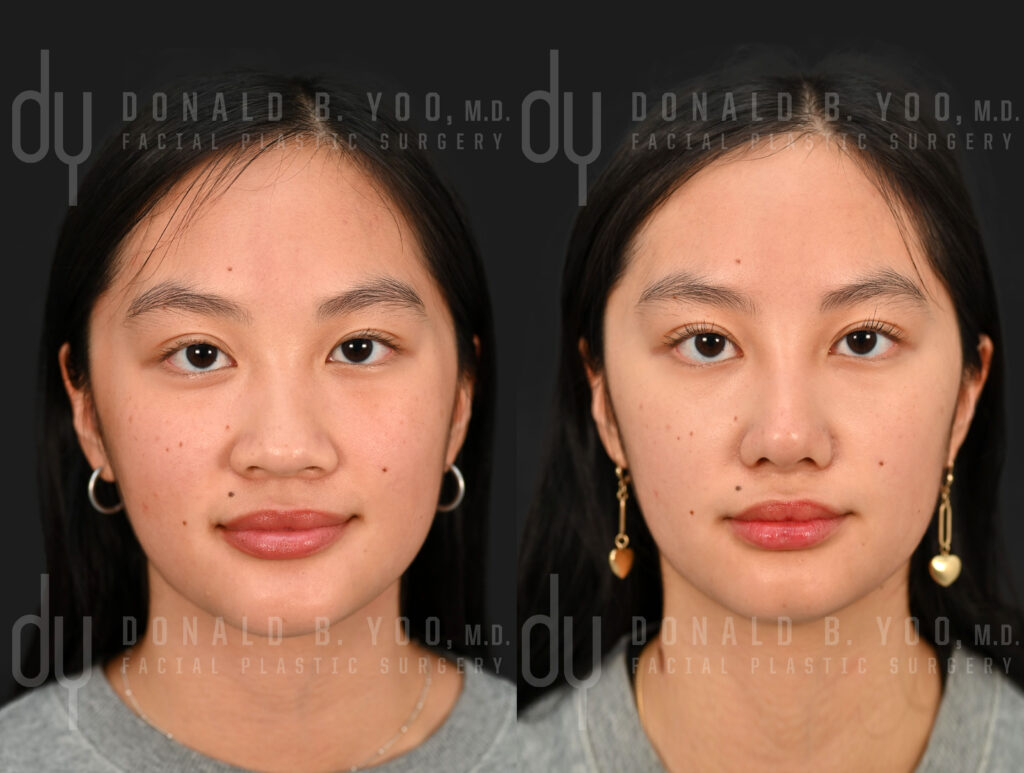
— not to move the nose toward a different ethnic ideal. This is a specific and deliberate surgical philosophy, not an incidental outcome.
This is most commonly associated with older silicone implant techniques, which can create a stiff, shiny, or overly straight dorsal appearance that doesn’t move or integrate naturally with the surrounding tissue. Contemporary autologous techniques, individually planned for each patient’s anatomy, are far less prone to this look.
This varies significantly by patient and goals, but most Asian rhinoplasty involves building dorsal height and improving tip definition and projection — additive changes rather than the reductive changes typical of Western rhinoplasty. The degree of change is planned around what will look proportionate specifically on that patient’s face.
Yes — reviewing a surgeon’s own before-and-after gallery, specifically looking at whether results look integrated with each patient’s individual facial features rather than uniform across different patients, is one of the most useful ways to evaluate whether a surgeon’s aesthetic approach aligns with your goals.
Yes. Thicker skin, common in many Asian noses, tends to soften and camouflage fine structural details more than thinner skin does, which actually works in favor of a natural appearance but also means structural changes need to be somewhat more deliberate to be visible at all beneath the skin envelope.
If you are weighing surgery against a more modest, temporary change, I explain what filler can and cannot do in my post on nonsurgical Asian rhinoplasty.
Final Thoughts
The most reassuring thing to understand about modern Asian rhinoplasty is that “natural” and “ethnically appropriate” aren’t competing goals with cosmetic improvement — they’re the actual objective. If you’re considering Asian rhinoplasty and want to discuss what a natural, individualized result would look like for your specific face, I encourage you to schedule a consultation.
Donald B. Yoo, M.D., F.A.C.S. is a double board-certified facial plastic surgeon and Medical Director of HALO Beverly Hills, specializing in Asian rhinoplasty, revision rhinoplasty, and alarplasty. His office is located at 433 N. Camden Drive, Suite 970, Beverly Hills, CA 90210.







 Contact Us