


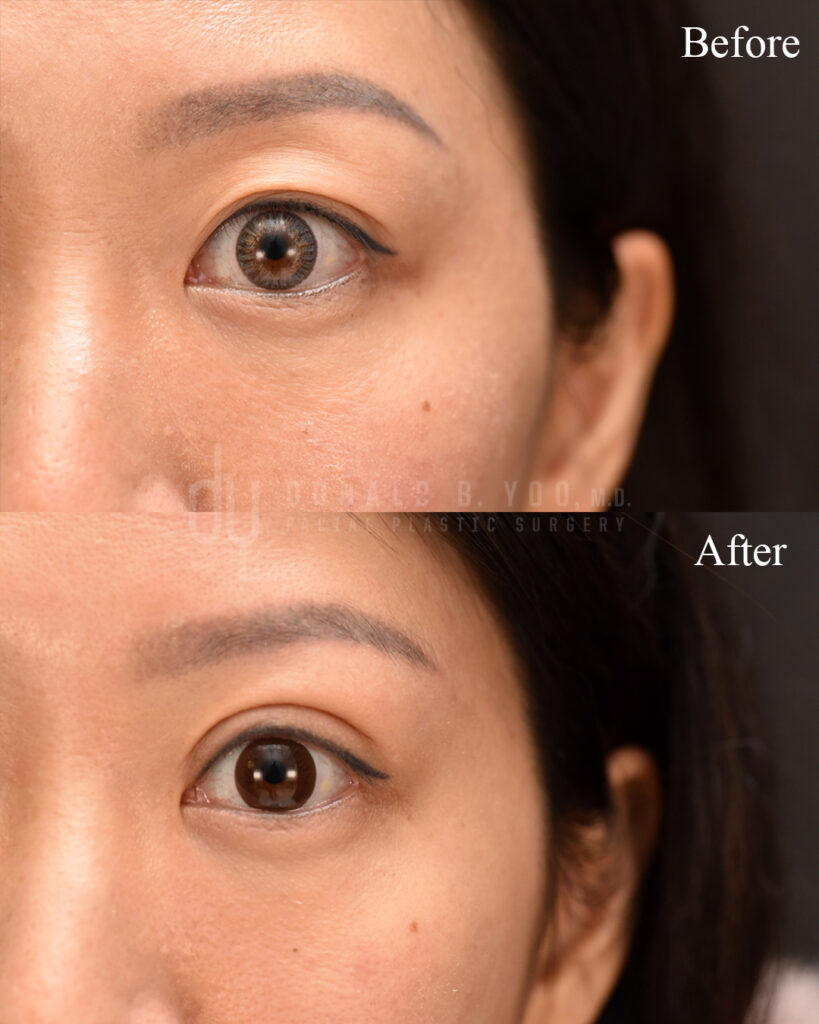
Double eyelid surgery — also known as Asian blepharoplasty or double eyelid crease surgery — is one of the most commonly requested procedures in Asian facial plastic surgery, and one of the most misunderstood. Patients often arrive at consultation having read conflicting information online about which technique is “better,” when in reality the right approach depends almost entirely on individual eyelid anatomy.
There are two fundamentally different ways to create a double eyelid crease: the incisional technique and the suture (non-incisional) technique. Understanding how each works — and who is actually a candidate for which — is the first step to getting a natural, durable result.
What Is Double Eyelid Surgery?
Many Asian upper eyelids lack a natural supratarsal crease, or have a crease that is low, uneven, or partially formed. This occurs because the levator muscle — the muscle responsible for opening the eyelid — does not attach as strongly or as high to the overlying skin as it typically does in eyelids with a well-defined crease. Without this attachment, the eyelid skin drapes evenly over the lash line rather than folding at a visible crease.
Double eyelid surgery recreates this attachment, allowing the skin to fold predictably at the desired height and shape, creating a defined upper eyelid crease.
The Suture Technique
The suture technique creates a crease without a full incision. Instead, small openings or punctures are made along the eyelid, through which sutures are passed to create adhesions between the skin and the underlying levator muscle. As these internal scars mature, they hold the skin down at the point of attachment, forming a crease.
Advantages:
- Minimal to no visible incision
- Faster initial recovery, with less swelling and bruising
- Reversible in some cases, since no tissue is removed
Limitations:
- Best suited for younger patients with thin eyelid skin, minimal fat, and little to no excess skin
- The internal adhesions can loosen over time, meaning the crease is more prone to fading, loosening, or disappearing entirely — particularly in patients with thicker skin or more eyelid fat
- Cannot address excess skin or significant fat prolapse
The Incisional Technique
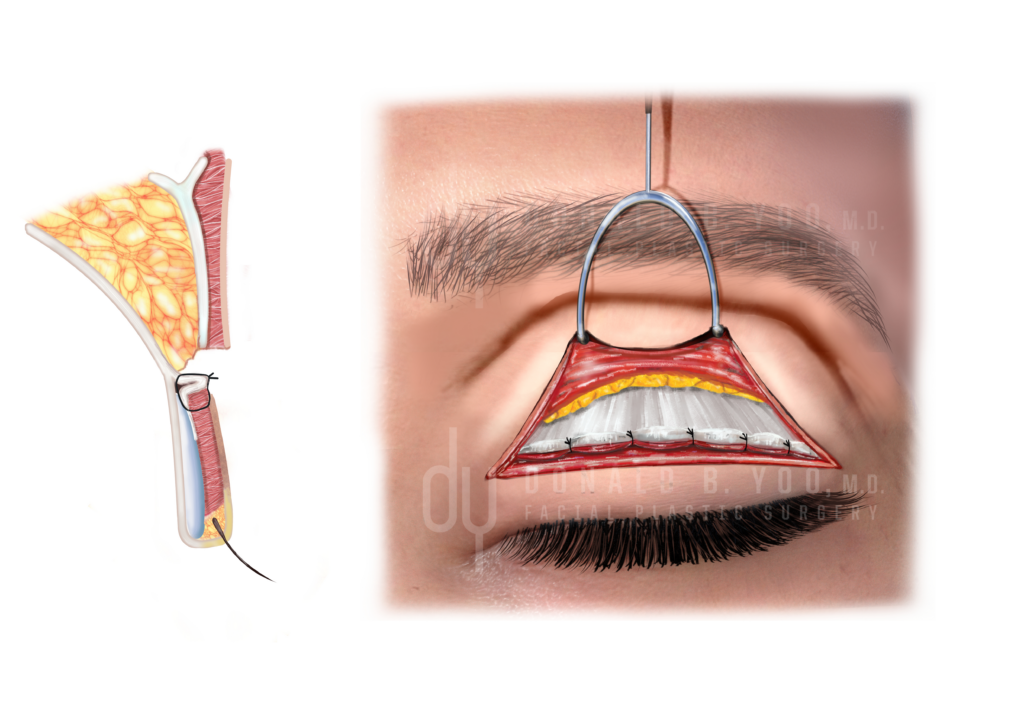
The incisional technique creates a permanent crease through a surgical incision along the intended eyelid fold. Through this incision, the surgeon can directly address excess skin, remove or reposition fat, and secure the levator muscle attachment to the skin with fixation sutures, creating a durable, permanent crease.
Advantages:
- Permanent and highly predictable, since the attachment is surgically fixed rather than relying on scar adhesion alone
- Allows for precise crease height and shape customization
- Can simultaneously address excess skin, fat, and eyelid asymmetry — common needs for patients with thicker eyelid skin or more mature eyelid changes
Limitations:
- Slightly longer initial recovery, with more swelling in the first 1-2 weeks
- A fine incision line is created, though when placed and closed meticulously it typically heals to become virtually imperceptible within the natural crease
Why Technique Selection Matters So Much in Asian Blepharoplasty
Asian upper eyelids vary considerably from patient to patient — in skin thickness, the amount of preaponeurotic fat, the presence or absence of an epicanthal fold, and the natural width and shape of the eye. A technique that works beautifully on one patient’s anatomy can produce a shallow, uneven, or short-lived result on another.
This is why I don’t default to a single technique for every patient. During consultation, I evaluate skin thickness, fat distribution, levator function, and the patient’s desired crease height and shape to determine whether a suture or incisional approach — or in some cases a hybrid — will produce the most natural and lasting result specific to that patient’s anatomy.
Incisional vs. Suture: A Side-by-Side Comparison
| Suture Technique | Incisional Technique | |
|---|---|---|
| Best for | Thin skin, minimal fat, younger patients | Thicker skin, excess skin/fat, mature eyelids |
| Permanence | Can loosen or fade over time | Permanent |
| Ability to remove skin/fat | No | Yes |
| Initial recovery | Faster | Slightly longer |
| Scar visibility | Minimal | Fine line, hidden within crease when healed |
Recovery After Double Eyelid Surgery
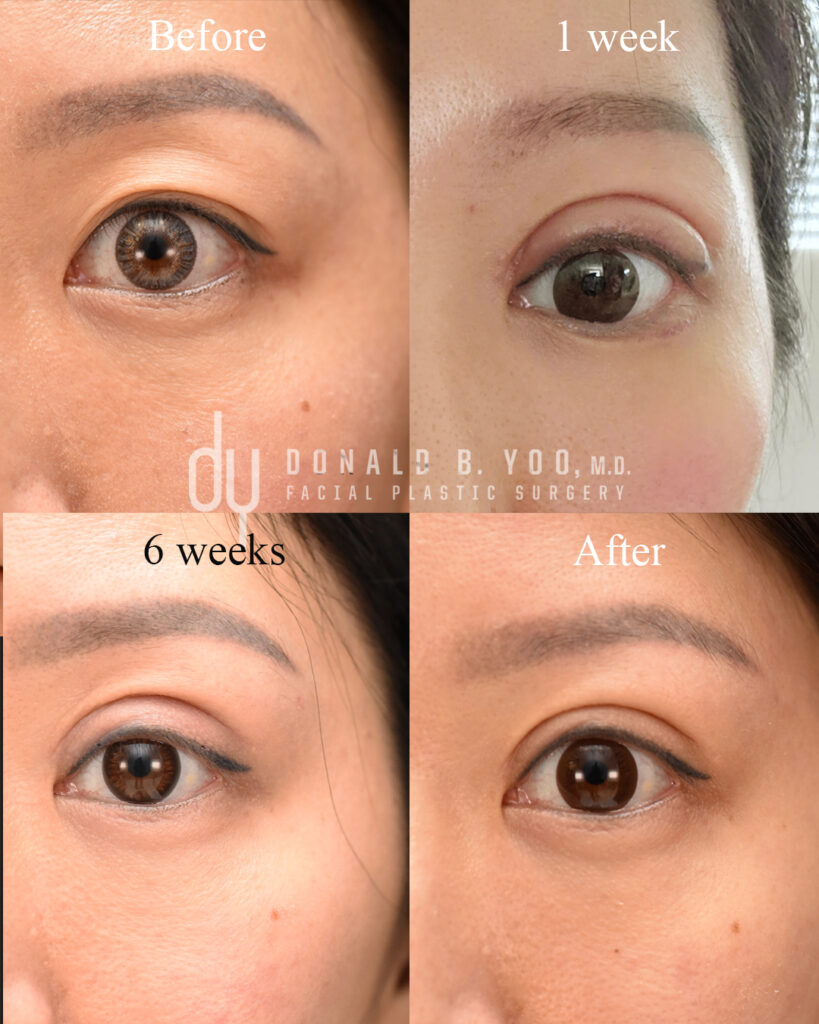
Regardless of technique, most patients experience swelling and bruising that peaks in the first 2-3 days and improves significantly over the following one to two weeks. Cold compresses and head elevation in the first 48-72 hours help minimize swelling. Sutures, when placed, are typically removed within about a week.
Patients undergoing the incisional technique should expect a longer window — often several weeks to a few months — before the crease fully settles into its final shape, as swelling resolves gradually and the eyelid tissue softens.
Frequently Asked Questions
Which technique lasts longer, suture or incisional?
The incisional technique is considered permanent, since the levator-to-skin attachment is surgically fixed. The suture technique relies on internal scar adhesion, which can loosen over time — meaning some patients who initially choose the suture method eventually pursue an incisional procedure for a more durable result.
Can double eyelid surgery be done without any visible scar?
The suture technique leaves no visible incision line, only tiny puncture marks that heal quickly. The incisional technique does create a fine incision, but when designed and closed carefully, it is placed directly within the new eyelid crease and typically becomes very difficult to see once fully healed.
Am I a candidate for the suture technique, or do I need the incisional approach?
This depends on your eyelid anatomy — skin thickness, amount of fat, and whether there is excess skin to address. Patients with thin skin and minimal fat are often good candidates for the suture technique, while patients with thicker skin, more fat, or any degree of skin laxity typically achieve a more predictable and lasting result with the incisional technique. An in-person evaluation is the most reliable way to determine which approach fits your anatomy.
Is double eyelid surgery the same as an upper blepharoplasty?
They are related but not identical. Double eyelid surgery specifically creates or defines an eyelid crease where one is absent or asymmetric. A traditional upper eyelid blepharoplasty, more commonly performed on eyelids that already have a defined crease, primarily removes excess skin and fat to address hooding or heaviness. Many Asian blepharoplasty procedures accomplish both — creating a crease while also addressing excess skin — within the same surgery.
How do I know what crease height and shape will look natural on me?
Crease height and shape should be proportionate to your eye shape, brow position, and facial structure — there is no single universal “ideal.” During consultation, I work with patients using photo-imaging to simulate different crease heights and shapes so we can align on a result that looks balanced and natural for your specific face before moving forward with surgery.
Final Thoughts
The suture versus incisional decision is not about which technique is objectively better — it’s about which technique matches your eyelid anatomy and goals. Choosing the wrong approach for your anatomy is one of the more common reasons patients seek revision of a double eyelid surgery performed elsewhere. Working with a surgeon experienced in both techniques, and in the anatomic nuances of Asian eyelids specifically, is the best way to get a result that looks natural and holds up over time.
If you’re considering double eyelid surgery and want to understand which technique is right for your eyelid anatomy, I encourage you to schedule a consultation.
Donald B. Yoo, M.D., F.A.C.S. is a double board-certified facial plastic surgeon and Medical Director of HALO Beverly Hills, specializing in revision and Asian rhinoplasty, alarplasty, and Asian blepharoplasty. His office is located at 433 N. Camden Drive, Suite 970, Beverly Hills, CA 90210. To schedule a consultation, visit www.donyoomd.com.


 Contact Us