


If you’re unhappy with the results of your rhinoplasty, you are not alone. According to studies, the revision rate after a primary rhinoplasty can reach 20% – meaning one out of five patients who undergo a nose job surgery will pursue a revision surgery at some point in their lives. Fortunately, for most patients, even with a botched rhinoplasty previously, the results can be corrected with revision surgery.
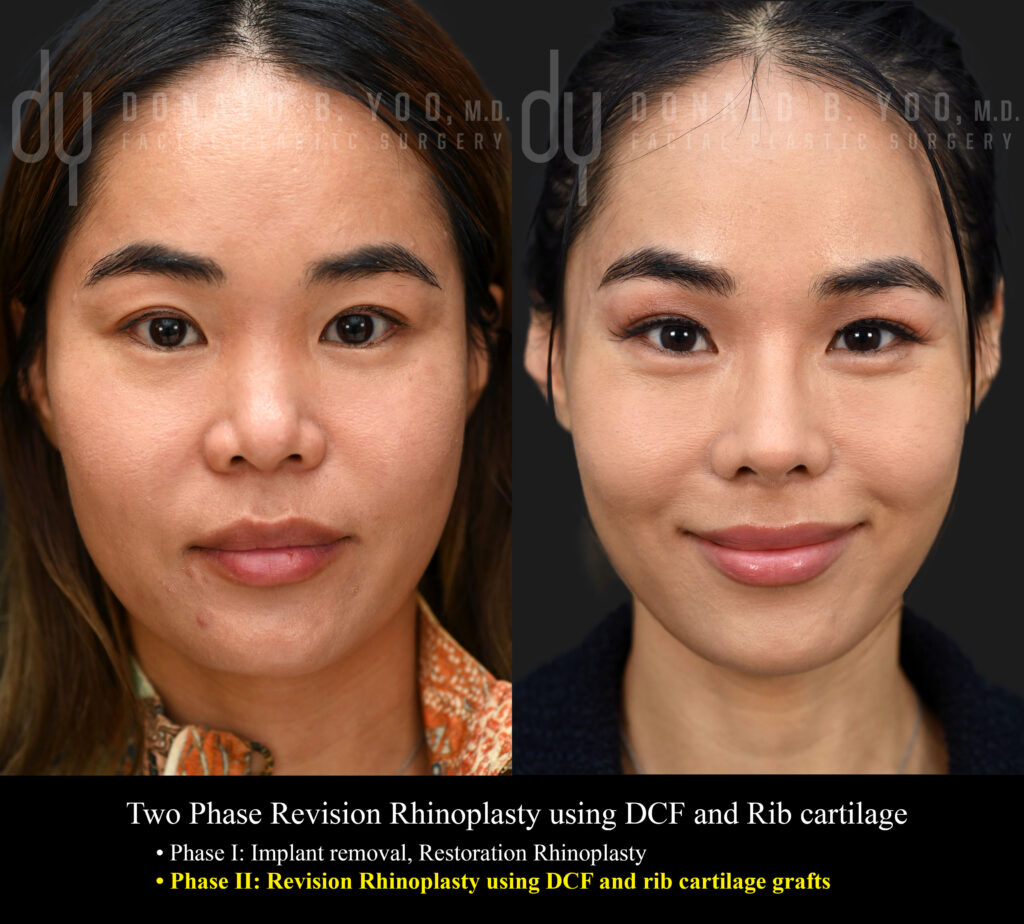
Asian rhinoplasty demands a different surgical approach than traditional rhinoplasty for both anatomical and aesthetic considerations. When a plastic surgeon does not adequately address the structural aspects of Asian anatomy, in addition to the effect of a thicker, more sebaceous skin envelope, the results often fail to meet the expectations of the patient.
Why Asian Rhinoplasty Requires a Different Approach
Softer, more pliable nasal tip cartilage, a lower dorsum (or nasal bridge) and thicker, more sebaceous skin compared to Caucasian anatomy means a different surgical approach must be taken. Common concerns for White patients undergoing rhinoplasty include a dorsal hump (bump along the bridge) or a wide, bulbous nasal tip. Nose job surgery remains relatively straightforward in these cases since since cartilage and bone can shaved or removed to reduce the hump and narrow the tip without too much concern that the structure of the nose will collapse. In addition, with relatively thin nasal skin envelopes, even small changes to the nasal framework will result in visible changes to the shape of the nose.
The Most Common Reasons for Failed Asian Rhinoplasty
- Incorrect selection of graft material
- Using synthetic grafts always lead to complications at some point. Some patients are lucky and will not see any major issues for 20-30 years, but inevitably problems will arise that relate to implant migration, visibility, infection or even extrusion through the skin. Common synthetic implants include: silicone, Goretex, and Medpor.
- Inadequate structural support
- For most Asian noses the cartilage shaping and supporting the tip of the nose is fairly weak and flexible. When the goal is to create definition and projection to the tip of the nose, this presents a less than ideal situation. If a rhinoplasty surgeon attempts to narrow the nasal tip in the same way he or she would narrow a White patient’s nose, the support of the nose weakens and is unable to show any definition through a relatively thicker skin envelope. In the worst botched rhinoplasty cases this will result in nasal valve collapse and an excessively pinched appearance to the nasal tip and ala, without any aesthetically pleasing “definition” added to the nose.
- Nostril and Tip Asymmetry
- Many patients seeking Asian rhinoplasty also seek to have slimmer and more narrow ala and nostrils. In order to achieve this, a rhinoplasty surgeon must have mastery of structural grafting techniques (often requiring harvest of rib cartilage) and alarplasty (nostril narrowing) techniques to create a nose that maintains a completely natural shape, while also optimizing refinement. Surgeons unfamiliar with these techniques often end up with nostrils and nasal tips that have obvious asymmetry and even deviation.
- Unnatural Aesthetics
- At the end of the day, the nose must be balanced with the rest of the face. As the central feature, it must enhance all the features around it and bring harmony to the face. A nose may look “fine” in isolation, but if the surgeon does not account for Asian aesthetics when shaping the nose, even a technically flawless operation can result in a botched nose.
What to Look for in a Revision Rhinoplasty Surgeon
If you’re considering revision surgery, look for:
- Board certification in facial plastic surgery
- Specific experience with revision cases, not just primary rhinoplasty
- Before-and-after photos of revision patients, not only first-time surgeries
- Experience with Asian and ethnic rhinoplasty specifically, given the anatomical differences discussed above
Final Thoughts
A disappointing rhinoplasty result can feel discouraging, but in most cases there is a path forward. Understanding why a result didn’t turn out as expected is the first step toward a successful revision.







 Contact Us