


The most common complications for any surgery include bleeding and infection, and this holds true for Asian nose job surgery as well. Risk factors for bleeding are often assessed and mitigated prior to surgery, such as the cessation of NSAIDs, aspirin-containing products, foods/supplements and other medications that may cause an increased risk of bleeding during surgery. Pre-operative lab studies and medical clearance seek to identify bleeding disorders such as coagulation abnormalities and platelet deficiencies prior to rhinoplasty. Surgeons can miminize the risk of bleeding during surgery by meticulously controlling hemostasis during the procedure and using electrosurgery to close any bleeding vessels during Asian rhinoplasty. When bleeding does occur it can typically be controlled without the need for a return to the operating room, most often in the form of nasal packing for a nose bleed that does not cease on its own.
Infection may occur after rhinoplasty with a frequency of 1-2%, depending on the patient’s comorbidities, types of graft material used, primary vs. revision surgery, and other factors that become more difficult to quantify such as their exposure to pathogens post-surgery, how strictly they perform hand hygiene, and intrinsic levels of resistance to infection. Synthetic grafts carry a much higher risk of infection that also remains for the lifetime of the implant. Autologous grafts, or tissue from one’s one body, become incorporated into the nose fully within 2-3 months. After this time the risk of infection dips back down to the pre-operated state. Signs of infection include increasing redness, tenderness, strange smell, crusting and/or drainage. The earlier an infection is detected, typically the easier it is to treat, and often can be treated with a combination of topical and oral antibiotics. Rarely, infections may progress to the point that higher-dose IV antibiotics may be needed.
Beyond the complications common to all surgeries, the other serious complications after Asian rhinoplasty include scarring and the need or desire for revision surgery. Whenever an incision is made through the skin, a scar remains, and while it is impossible to create a truly invisible scar, with proper scar-design and precise surgical technique most scars during Asian rhinoplasty will be extremely discrete and become nearly invisible with proper care. Precise surgical technique includes tension-free closure and perfect re-approximation of skin edges to create the thinnest, faintest scar possible. Scar revision and scar modulation treatments are a possibility to improve the appearance of most scars.
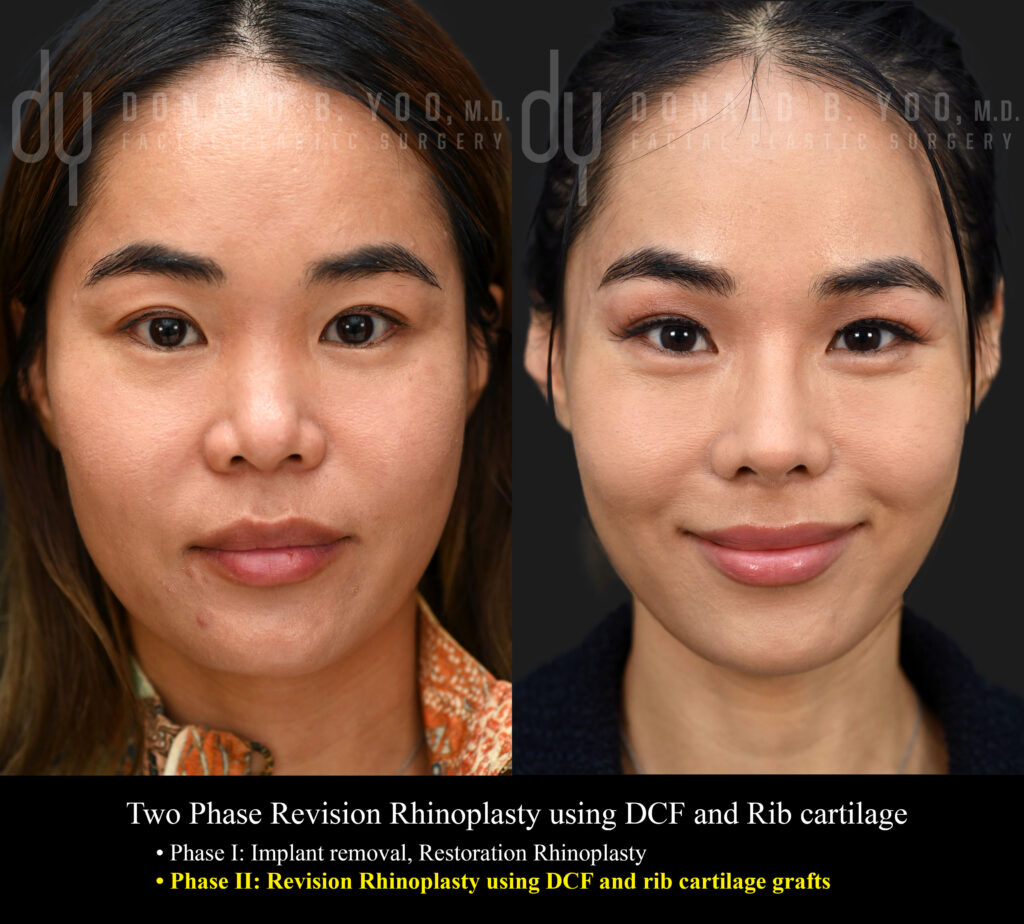
The risk of needing/wanting revision surgery after Asian rhinoplasty is intimately tied to two main factors: 1) the skill and experience of the rhinoplasty surgeon 2) the expectations of the patient. Patients have an expectation in terms of aesthetics and recovery when they seek out a surgeon for an Asian nose job. Some will even bring “inspo” and “goal” photos. The reality is, it’s not usually possible to replicate a nose on someone’s face that has completely different anatomy and facial aesthetics, nor would it be desirable to do such a thing. The perception of beauty more often flows from the balance and harmony between facial features, not simply one outstanding physical feature. Some surgeons inherently understand this while others work hard to incorporate this tenet in their work. Others, however, fail to fully master this concept and this results in patients seeking improvement upon their rhinoplasty.
Even when aesthetically aligned, many rhinoplasty surgeons lack the technical expertise and surgical precision to create the shape and results a patient seeks. That’s why it’s important as a patient not only to research a surgeon’s background including educational and training credentials, but also to carefully review examples of their before and after photos, videos and candid patient videos or social media accounts to ensure the aesthetic is one he/she is capable of achieving.


 Contact Us