


The contemporary landscape of Asian rhinoplasty involves advanced structural and contour grafting coming from an autologous source – meaning from the patient’s own body. Rudimentary techniques using synthetic implants like silicone, Medpor and Goretex are gradually being discarded as more and more surgeons begin to receive training to properly perform the more complex, but ultimately superior, Asian nose job techniques using 100% natural and permanent material.
Rib cartilage provides an ample source of viable, autologous cartilage that is not only strong, but allows for shaping long, straight cartilage grafts that can serve to reinforce the septum, open the nasal valves, and support the tip of the nose, amongst other applications. The workhorse of creating ample, durable nasal tip projection in Asian rhinoplasty remains the septal extension graft, albeit in a slightly different form than the originally described by Byrd. The modern septal extension graft takes on a more robust form, often secured in the mid-line between extended spreader grafts and with a posterior notch to accommodate the anterior nasal spine. The septal extension graft allows for projection of the nasal tip, precise rotation of the nasolabial angle, and may also be used to control lengthening of the nose and the appearance of the columella and infratip lobule. Meanwhile the extended spreader grafts serve the dually important functions of expanding the internal nasal valve, thereby improving the nasal airway, and stabilizing the dorsal and caudal septum to allow for mid-line preservation of the additional tip support.
During Asian rhinoplasty the lower lateral crura can then be secured to the septal extension graft, which serves as the novel anterior septal angle. Lateral crural tensioning provides immediate flattening of convex lateral crura, while maintaining strength and patency of the external nasal valve. The external nasal valve receives additional support and structure from the addition of alar rim grafts, part of the unified tip grafting technique. The unification occurs at the transition between the alar lobule and the lateral tip, as the medial aspect of the alar rim grafts insert discretely along the ventral aspect of the tip refining graft, which itself is secured over the intermediate crura and anterior most aspect of the septal extension graft. This ensures a smooth transition from nasal tip to ala while also create greater refinement of the lateral tip and alar lobule.
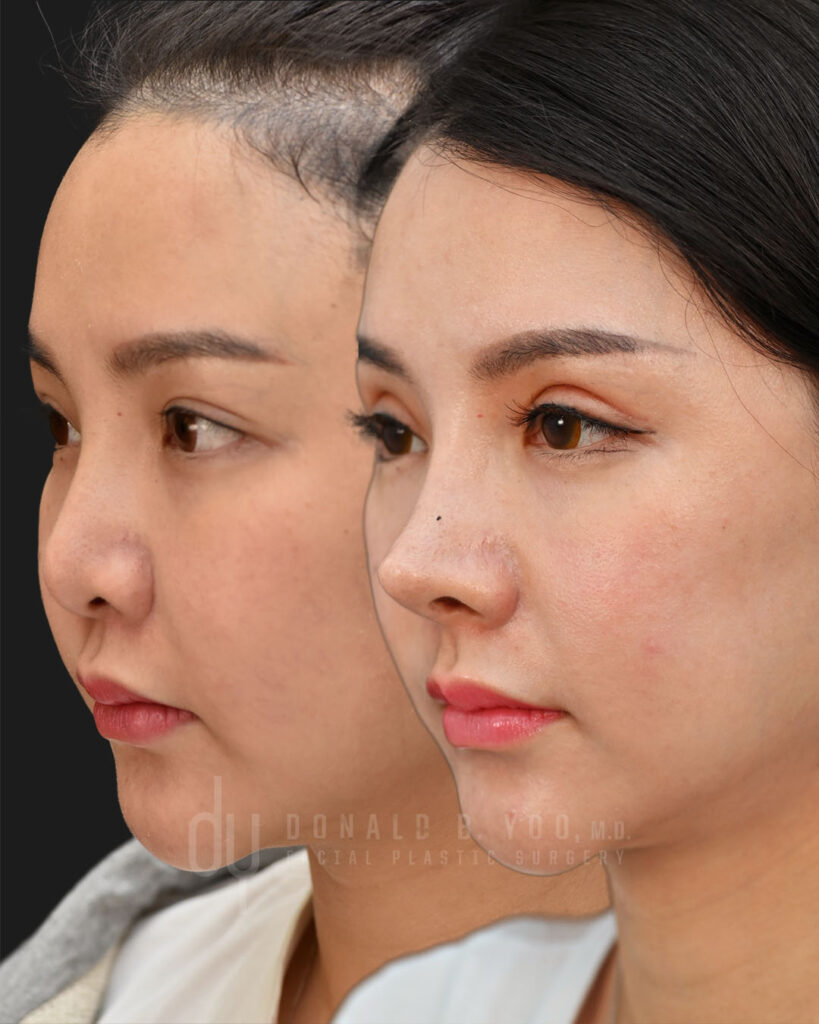
At times, a tip-refining shield graft or columellar onlay will necessitate itself to lend volume to the columella and infratip lobule. These grafts, in combination with a properly shaped and secured septal extension graft, ensure appropriate columellar show and prevent the unsightly appearance of a retracted columella. When executed at a high level what results is a delicate infratip break that enhances the balance and femininity of the nose especially on lateral profile and oblique views. The Asian rhinoplasty surgeon must take special care to create a proportional double-break along the infratip to preserve the facial balance.


 Contact Us